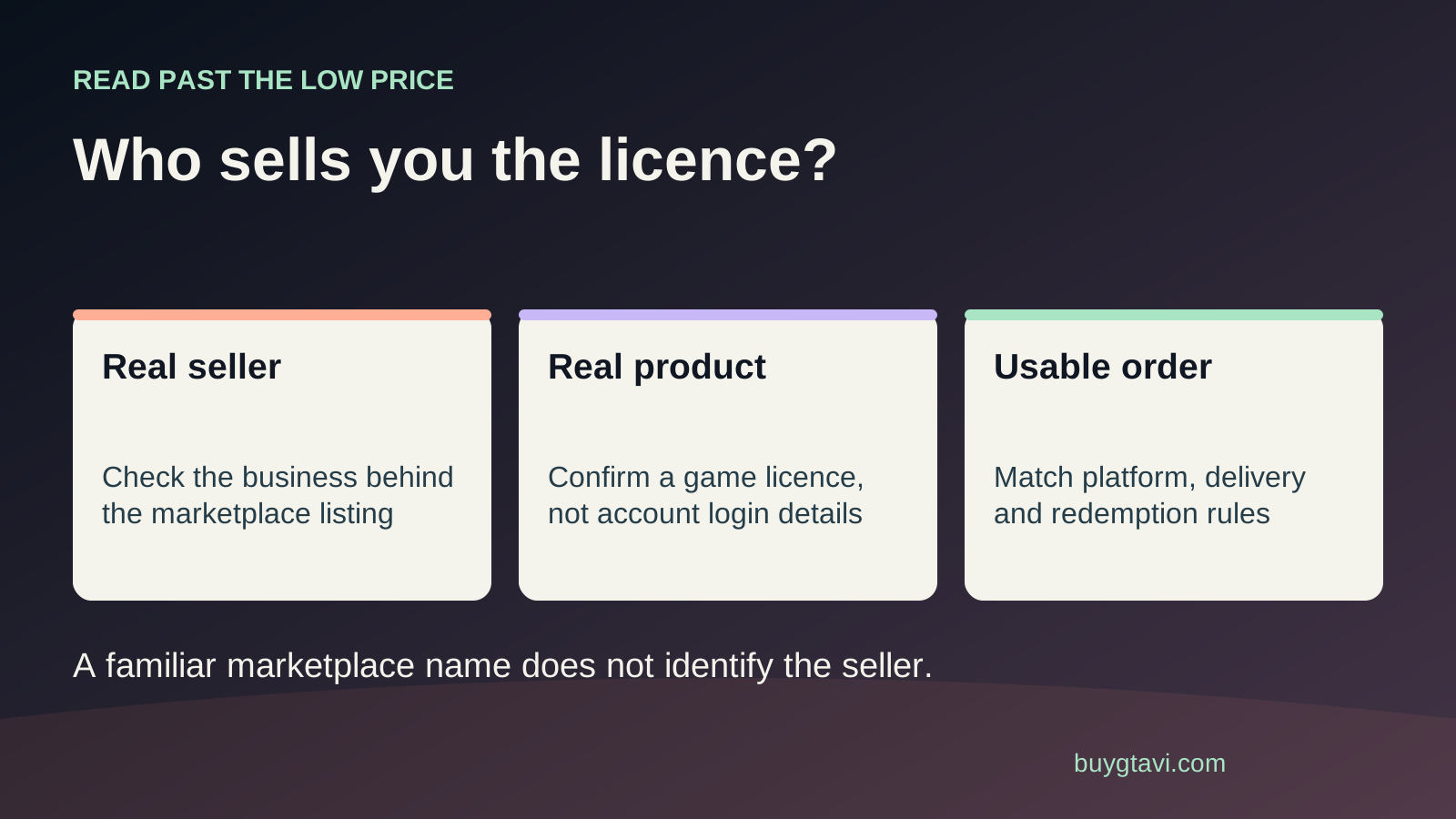
A familiar marketplace name does not prove that the marketplace itself sells the GTA VI listing you found. Check who is selling, what you receive and which account gains the game. A legitimate purchase route should describe a compatible product and usable licence or code, not require someone else's account login. Verify the listing's delivery and protection terms before comparing its price with the platform store.
| Listing says | Check before paying | Why it changes the decision |
|---|---|---|
| Sold by a third party | Seller identity and support responsibility | Marketplace branding does not identify the seller |
| Code delivered by email | Authorisation, region and digital-item protection | Parcel protection may not apply |
| Boxed copy | Code-only format, condition and code status | A package alone does not prove access |
| Account included | Account-control and platform terms | Login access is different from a licence on your account |
| Worldwide | Exact platform and account-country eligibility | A broad label does not settle product restrictions |
Find the business actually selling the item
A marketplace can bring many sellers together on one website. That can make comparison convenient, but it also makes the product page easy to misunderstand. The website's logo may be large while the seller name is small. Find the sold-by field, seller profile and invoice details. Then check who takes responsibility for delivery, a faulty code and a refund request. These roles might belong to different businesses.
Also separate sold by from shipped by. A marketplace or warehouse handling the parcel does not automatically become the seller or prove where a download code came from. Delivery support and product legitimacy are related, but they answer different questions. The package reaching your door would not settle whether a code is unused and compatible with your account. You need a clear seller and a clear product before the fulfilment method becomes useful.
Ask what enters your account after payment
A useful listing says whether you receive a boxed download code, an electronically delivered code, platform-store credit or something else. It identifies the game, platform and edition. Rockstar's official information describes PS5 and Xbox Series X|S versions, and a retail box containing a code rather than a disc. Compare the listing to the announced product instead of accepting any page with GTA VI in its title.
Ask a plain question: 'Will I redeem a code on my own existing account, or are you giving me access to another account?' If the seller answers with login details, a shared profile, offline activation or instructions not to change account settings, that is a different transaction from a normal game purchase on your account. Do not treat the ability to start a game once as proof that you acquired the advertised product.
A seller may use the word key loosely. That word does not tell you whether a code exists for the promised platform and format. Require the full description and redemption route. A supposed PC purchase, for example, needs an official announcement of the relevant PC product; the current Rockstar support information checked here names the console versions. Our PC status guide keeps that question separate from console offers.
A licence is the right to use the game under its terms
In a digital purchase, licence means the permission to use the content under the platform and publisher's conditions. It is not the same as buying a freely transferable physical object. A code can place that permission on the account that redeems it. A box can contain that code without containing a disc. This is why product format and account destination matter even if the seller mainly talks about a low price.
An account-login sale makes the destination especially unclear. Who controls recovery details? Can the original holder recover the account? Does the platform allow the proposed arrangement? Will a later restriction remove your access? Do not answer these with the seller's reassurance that everyone does it. Read the relevant platform terms and choose a purchase route you can keep using without depending on a stranger's continuing control of an account.
A named seller and an invoice help establish what was promised, but they do not turn an unsupported product into a supported one. The stronger evidence combines a real business, an exact product, a compatible redemption route and written handling of problems. That is the combination to seek before a bargain becomes worth considering.
Make the listing prove its platform and region
Match the product to the console you own and the account you intend to use. A PS5 code cannot become an Xbox purchase because the seller's title also mentions Xbox. If the page bundles several platform choices, check the selected option again at checkout. Sellers can use one shared page for different products, so the main picture may not match the variant in your cart.
Then check the region information against the official instructions for that specific product. Rockstar lists regional groups for PlayStation GTA VI codes and says Xbox GTA VI game codes are not region-locked. That does not make every gift card, payment method or unrelated product worldwide. A listing that sells store currency needs the currency product's own rules. Our region guide explains the game's code route in more detail.
If the seller says worldwide, ask what that means for your account country and platform. Save the written answer with the listing. A broad marketing word cannot outweigh a documented restriction. If the seller's explanation requires you to pretend you live elsewhere, use a VPN or hand over your login, stop treating the offer as a simple compatible purchase. A small price difference is poor value when it creates an account problem you did not want.
Read the protection policy for this item type
Buyer protection is not one universal promise. Marketplaces can have exclusions for digital items, codes, classified ads or transactions completed outside their checkout. Read the policy that applies to the exact delivery type in the listing. A banner about safe shopping is not enough when the terms name exceptions. Knowing who handles a dispute matters before paying, while you can still choose another route.
eBay provides a concrete example. Its current electronically delivered items policy sets requirements for approved sellers and excludes unauthorised software keys. It also says electronically delivered goods do not qualify for eBay Money Back Guarantee. That policy is not a judgment on every GTA VI listing; it shows why an emailed code needs its own protection check instead of borrowing the confidence you might have in a physical parcel purchase.
A physically shipped box and an emailed code may therefore need different policy checks, even if they ultimately provide access to the same game. Confirm how the item is classified and which terms apply. If the seller says a platform guarantee covers it, read the guarantee itself. If the policy and the seller's promise disagree, require clarification before payment rather than planning to argue about it afterward.
Seller feedback helps, but read the right feedback
A seller can have excellent feedback from unrelated products. That tells you something about its history, but it does not establish the origin or usability of this game's code. Look for relevant, recent comments about the same delivery type and how problems were resolved. Read the description of a complaint rather than only counting negative ratings. A late parcel and a previously redeemed code call for different remedies.
Reviews attached to a shared product page may also describe other sellers or variants. Check what the review actually identifies. A happy buyer of a controller does not prove a seller's digital licence route. A review saying a login worked on the first day does not establish a lasting right to use the game. Use feedback to find questions worth asking, then require the listing's own written answers.
Question a discount without assuming every discount is fake
A lower price can have a normal explanation: a promotion, a package difference, a different market or a seller accepting a smaller margin. It can also hide a product that is not equivalent to the one you wanted. Compare the same platform, edition, account compatibility, delivery method and final total. If one listing is actually credit or shared access, it should not sit beside a complete game purchase as if the two were identical.
Ask for the explanation when the gap is large. The seller does not need to disclose every private business detail, but it should describe what it is authorised to supply and what you will receive. A claim such as lifetime access needs its limits in writing. No marketplace seller can sensibly establish every future platform decision simply by using that phrase. Value the actual purchase terms rather than an unlimited-sounding promise.
Keep pressure tactics out of the calculation. A countdown or message saying only one remains is not evidence about the game's digital availability or your personal deadline. If the offer cannot survive the few minutes needed to identify the seller and product, it is a poor fit for a purchase you want to make confidently. The preorder timing guide helps distinguish a real reason to act from launch excitement.
Keep payment and messages inside the supported process
Use the marketplace's supported checkout for the transaction you are evaluating, and keep important promises in its messaging system where possible. A seller offering a discount if you pay directly elsewhere may change the protection route. Read the platform rules before agreeing. If the seller changes the payment instructions after the listing, reassess the purchase rather than treating that as a routine next step.
Never send your console password, recovery code or two-step sign-in code so a seller can activate the purchase for you. A normal code-redemption route lets you use the official platform yourself. If there is an error, preserve the message and request support through the recognised channel. The seller can investigate its order and code supply without controlling your gaming account.
Before paying, save the exact listing, selected variant, seller name, stated delivery date, total and relevant terms. Do not save or share other people's sensitive details unnecessarily. This small record establishes the offer you accepted if the seller later edits the page. It is much more useful than a screenshot of only the game artwork and low price.
Check delivery without exposing a valuable code
When the order arrives, compare it to the promise. For a box, inspect the platform, edition and condition before opening. For an electronic code, use the official redemption route on the intended account. Do not publish the full code or ask a stranger to test it. Once a code has been used on another account, your original buying problem can become harder to resolve.
If the code fails, record the exact error, time and account country without putting private account data in public. A wrong-product error, a region mismatch and an already-redeemed message are different facts. Contact the seller through the marketplace order, then follow the applicable dispute process within its stated time limits. Ask for the remedy that fits the failure: correct compatible product, replacement where appropriate or a refund under the relevant terms.
Avoid buying a second listing while you are still unsure whether the first worked. Check your game library and transaction history where relevant. Our code troubleshooting guide helps with region evidence, while the used-box guide deals with code status. A careful check can separate a genuine delivery failure from an account or redemption mistake.
Use a clear decision rule
Proceed only when you can identify the seller, the exact product, the account destination, the delivery promise and the problem-handling route. If a missing answer could leave you without usable access, get that answer before payment. If the route depends on a stranger's login or contradicts official product information, choose a clearer purchase instead. That is a practical buying rule, not a claim that every third-party seller is dishonest.
The right marketplace offer can save money while meeting your needs. The wrong one can sell something different under a familiar game's name. Your job is to compare usable purchases rather than attractive headlines. Once seller, licence and compatibility are clear, the price finally becomes a useful part of the decision.
Source desk
Product details checked 2026-10-14. Live store terms can change.
- Rockstar: GTA VI formats, platforms and code regions ↗ Checked 2026-10-14
- eBay: electronically delivered items policy ↗ Checked 2026-10-14
- PlayStation US: account and digital content terms ↗ Checked 2026-10-14
- PlayStation: voucher redemption restrictions ↗ Checked 2026-10-14